
America’s Data Center Boom: Exposing the Impact on Communities and Infrastructure


The expansion of data centers across the United States is often discussed as a technological milestone, framed around artificial intelligence, cloud computing, and the infrastructure required to support a digital economy. At a distance, it can seem like a story about progress and capability. But for the communities where these facilities are actually being built, the experience is far more immediate and far more tangible.
What once operated quietly in the background has moved into plain view. Large-scale developments now appear on the edges of towns and cities, bringing with them not just construction, but long-term changes in how local resources are used. Energy demand increases, water usage becomes a consideration, and infrastructure planning shifts in response to a type of facility that did not previously exist at this scale. The result is a growing awareness that the data center boom is not just a technology story. It is a community story.
When Infrastructure Becomes Visible
For many years, data centers were largely invisible to the public. They were understood in abstract terms, as part of the systems that made the internet work, but they rarely entered everyday conversation. That has changed as the scale of these facilities has increased.
Modern data centers are no longer small, isolated buildings. They are large, power-intensive developments that require coordination with utilities, local governments, and regional planning authorities. Their presence introduces new considerations into communities that were not designed with this type of infrastructure in mind.
As a result, people are no longer simply hearing about technological growth. They are seeing and feeling its impact in real time.
The Reality of Data Center Energy and Resource Demand
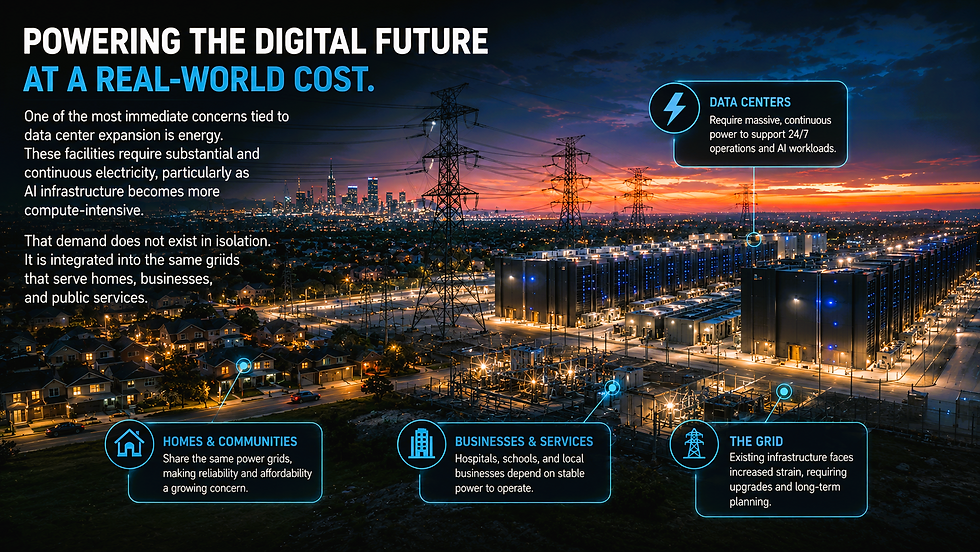
One of the most immediate concerns tied to data center expansion is energy. These facilities require substantial and continuous electricity, particularly as AI infrastructure becomes more compute-intensive. That demand does not exist in isolation. It is integrated into the same grids that serve homes, businesses, and public services.
As demand increases, questions naturally follow. How is that energy being sourced? How is it being allocated? What happens when multiple large-scale developments enter the same region at once?
Water usage adds another layer to the conversation. Many cooling systems depend on water to manage the heat generated by high-density computing. In areas where water resources are already limited or carefully managed, this becomes more than a technical detail. It becomes a community concern.
These are not theoretical issues. They are practical realities that shape how people experience the presence of these facilities.
When Growth Creates Pressure
The situation around Lake Tahoe illustrates how these dynamics can begin to surface. Residents served by a regional utility have been placed in a position where their provider must now secure a new long-term power source after an existing supply arrangement is set to end. While utilities have made it clear that service will continue, the situation has raised broader concerns about how energy capacity is being managed in regions experiencing rapid infrastructure expansion.
The takeaway is not that communities are suddenly losing access to electricity. It is that large-scale demand introduces new pressure into systems that were not originally designed for it. That pressure affects planning decisions, long-term capacity strategies, and the balance between existing needs and new development.
This is where the issue becomes more than technical. It becomes structural.
Responsible Development Cannot Be an Afterthought
As the scale of data center development increases, responsibility becomes a central consideration. Building infrastructure to support advanced technology should not come at the expense of the communities that support it.
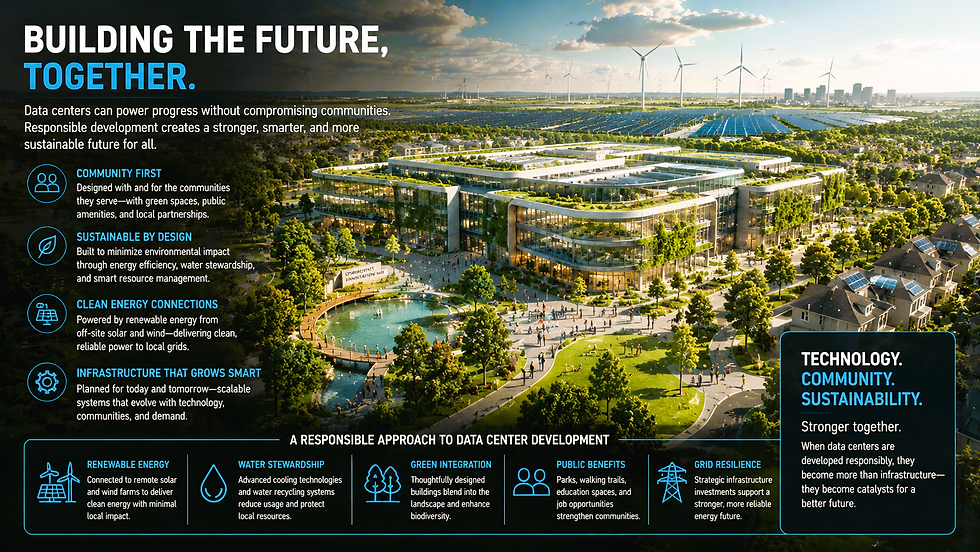
Responsible development requires more than meeting immediate demand. It requires anticipating the long-term impact of that demand and ensuring that supporting systems evolve alongside it. Energy capacity must expand in parallel with consumption. Water usage must be managed in a way that reflects local conditions. Infrastructure planning must account for both current residents and future growth.
When these elements are aligned, development can proceed in a way that supports both technological progress and community stability. When they are not, tension becomes inevitable.
Conclusion
The growth of data centers is often framed as a measure of technological advancement, but its most important implications may be found at the local level. Communities are not just hosting these facilities. They are absorbing the impact of their presence.
As the expansion continues, the question is no longer simply how much infrastructure can be built. It is how that infrastructure is integrated into the environments where people live.
The future of data center development will depend on more than technical capability. It will depend on whether growth can be aligned with responsibility, and whether progress can be achieved without shifting the burden onto the communities that support it.



Comments