
America's Data Center Boom: Exposing the Competing Priorities Hidden In the Data

If Data Centers Aren't Being Built to Spy on Americans, Then Why Are They Getting So Big?

Every few weeks, another massive data center project appears somewhere in the country. Communities hear about multibillion-dollar developments. Power companies warn about rising electricity demand. Residents see plans for facilities spanning hundreds or even thousands of acres. The headlines mention artificial intelligence, cloud computing, energy use, and infrastructure investments so large they can feel almost unreal.
The same question keeps coming up. Why would anyone need something that big?
For many people, the answer feels obvious. They assume these facilities are being built to store everyone’s personal information. Every message, every location, every transaction. The data center becomes, in the public imagination, a surveillance vault.
That concern is not irrational. Privacy risks are real, and people have every reason to question how information is collected and used. But the surveillance explanation by itself does not fully explain the scale of what is happening.
The larger shift is that the modern data center is no longer just about storing information. It is about powering intelligence.
Data Center, AI Infrastructure, and the Real Driver of Scale
For years, a data center was understood as a place where digital information lived. Websites, financial systems, streaming platforms, and business software all required storage and processing. That function still exists, but it is no longer the primary driver of growth.
Today, data centers are becoming AI infrastructure. That means they are not just storing data. They are actively processing it, learning from it, and using it to build systems that interact with the real world. The difference between storage and AI infrastructure is the difference between keeping information and transforming it into decision-making capability.
This distinction explains why the facilities are becoming so large. The demand is not driven by how much data exists. It is driven by how much computation is required to turn that data into usable intelligence.
Why the Surveillance Explanation Feels Incomplete
The surveillance narrative feels believable because people already understand that data is being collected in many ways. Phones track location. apps request permissions. cameras are more common. digital systems record behavior. When people see massive data centers, the natural assumption is that all of that information is being stored somewhere permanently.
Part of that assumption is true. Modern life produces large amounts of data. But the critical mistake is assuming that storage is the main reason for the scale of the buildout.
The expensive part is not storage. It is computation.
AI systems require enormous processing power to train models, run simulations, interpret sensor data, and deliver real-time decisions. A modern data center is not simply holding information. It is constantly working on that information.
That is the piece most discussions are missing.
Why AI Infrastructure Requires So Much Scale
The simplest way to understand this shift is to look at systems that interact with the real world. Autonomous vehicles are a clear example. A self-driving system is not just storing data. It is interpreting complex environments in real time. It must understand traffic patterns, pedestrians, weather conditions, unexpected obstacles, and human behavior.
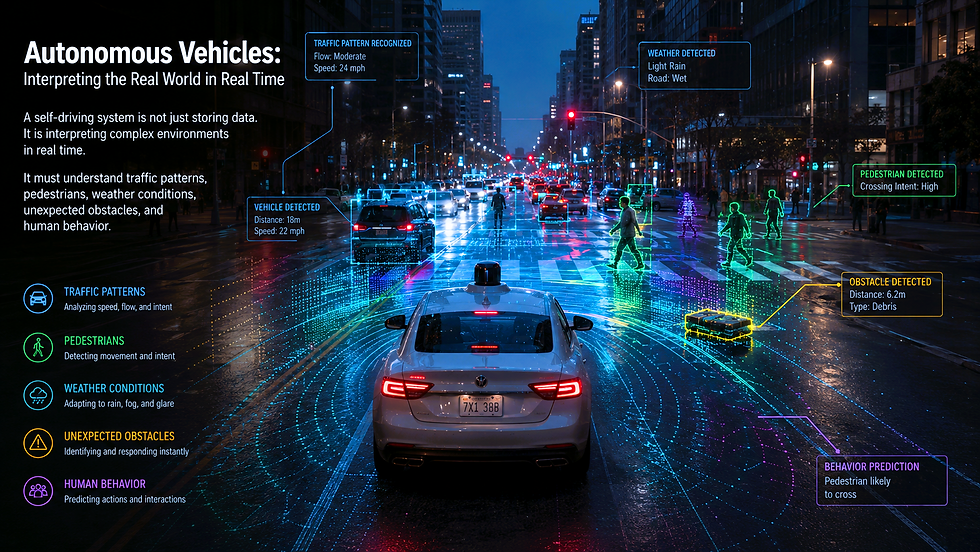
The most valuable data is not routine activity. It is the rare, unpredictable moment. Those moments are used to train and improve the system.
That process requires a continuous loop. Real-world events are collected, processed, analyzed, and used to improve future performance. The data center becomes part of a system that learns, not just a place that stores.
This is what defines AI infrastructure.
It is not static. It is active.
The same pattern applies beyond vehicles. Robotics, drones, and automated systems all depend on data, simulation, and continuous improvement. These systems require large-scale computing environments to function reliably and safely.
That is why the infrastructure demand is so high. The data center is not just storing what happened. It is helping machines learn what to do next.
The Real Constraints Behind the Data Center Boom
Another reason these facilities appear so large is that the constraints are not only digital. They are physical.
Power is one of the biggest limiting factors. AI workloads require significant electricity, especially when running advanced processors at scale. The challenge is not just building servers. It is ensuring the grid can support them.
Cooling is another constraint. High-performance computing generates heat, and that heat must be managed. As systems become more powerful, cooling becomes more complex and more resource-intensive.
Location also matters. Land availability, infrastructure access, fiber connectivity, and regulatory approval all shape where data centers can be built and how large they can become.
These constraints explain why projects are planned years in advance and built in phases.
The infrastructure must be ready before the computing demand fully arrives.
From the outside, a facility may look oversized or underutilized. In reality, it is often being prepared for future capacity.
Why This Matters for the Public Conversation
The debate around data centers often focuses on a single dimension. Some people focus on surveillance. Others focus on energy use or environmental impact. Those concerns are valid, but they are incomplete when viewed in isolation.
The reality is that multiple priorities are competing at the same time.
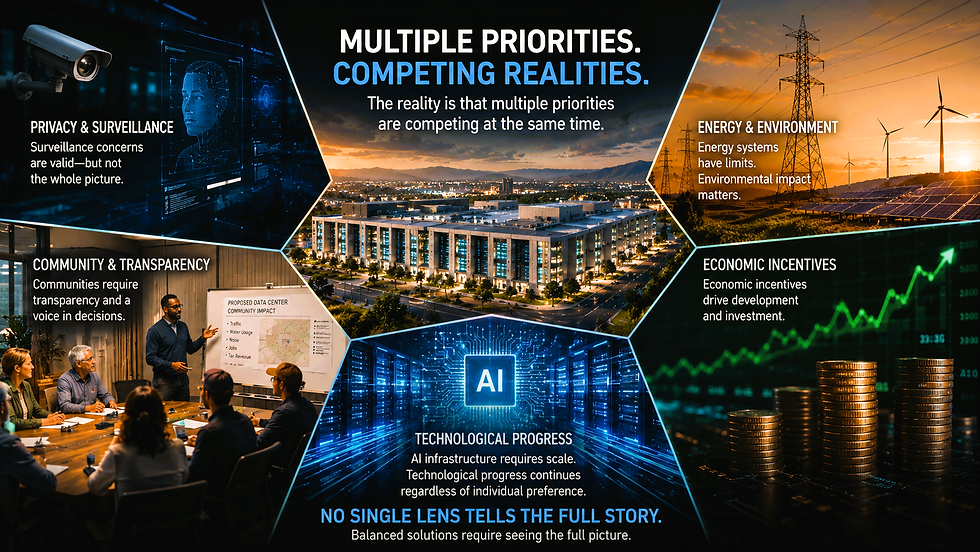
AI infrastructure requires scale. Communities require transparency. Energy systems have limits. Privacy expectations continue to evolve. Economic incentives drive development. Technological progress continues regardless of individual preference.
Understanding the data center boom requires looking at all of these forces together.
The issue is not whether data centers are good or bad. It is that they are becoming essential to systems that are increasingly embedded in daily life.
Conclusion
America’s data center expansion is not simply about building larger storage facilities.
It is about building the infrastructure required for machines that see, learn, predict, and act. Autonomous systems, robotics, and real-time AI applications depend on continuous computation at scale.
That does not eliminate concerns about privacy or oversight. Those concerns remain important. But they do not fully explain why these facilities are growing so rapidly.
The deeper reason is functional.
The economy is moving toward systems that require constant intelligence, not just stored information. That shift is what is driving the size, power demand, and visibility of modern data center development.
The conversation should not stop at whether data is being collected.
It should also ask a broader question.
What kind of AI infrastructure is being built, and how will it shape the systems people interact with every day?
If information is Power, then identifying and exposing hidden constraints is a Superpower.
Which would you rather have driving your business decisions?



Comments