
America’s Data Center Boom: The Cosmic Solution for When Data Processing Starts Outgrowing the Planet

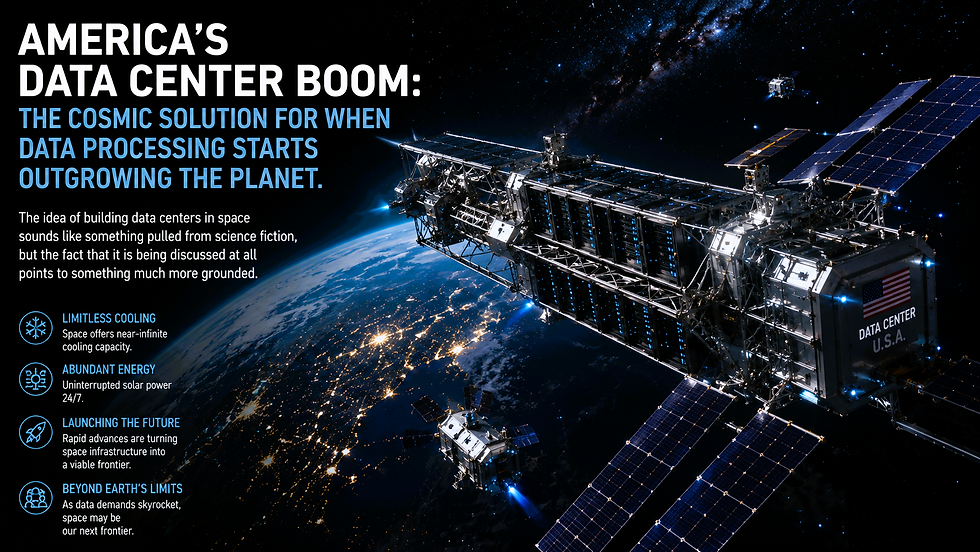
The idea of building data centers in space sounds like something pulled from science fiction, but the fact that it is being discussed at all points to something much more grounded. It suggests that the current expansion of data center infrastructure is not just growing rapidly, but beginning to encounter real physical limits.
Across the United States, large-scale data center development continues to accelerate. These projects are becoming more visible not only because of their size, but because of the strain they place on local resources. Communities are being asked to support increasing electricity demand, new transmission requirements, and more complex infrastructure planning. At the same time, the underlying driver of this growth is not simply cloud storage or traditional computing. It is the rise of AI infrastructure.
The Shift From Storage to AI Infrastructure
Modern AI systems do not operate as passive repositories of information. They require continuous processing, model training, simulation, and real-time inference. This creates a fundamentally different type of demand. Instead of simply storing data, these systems must constantly work on it, transforming raw inputs into usable intelligence. That shift changes the scale of infrastructure required to support them.
This demand is already measurable. Global electricity use from data centers is projected to roughly double from 485 terawatt-hours in 2025 to about 950 terawatt-hours by 2030, with AI acting as the primary driver of that increase. Such growth does not occur in isolation. It places pressure on power grids, increases competition for energy resources, and forces developers to think differently about where and how new facilities can be built.
Power and Cooling Are Becoming Core Constraints
Power is only one part of the constraint. Cooling has become an equally important issue. As computing density increases, so does heat generation, and managing that heat requires increasingly sophisticated systems. Traditional air cooling is often no longer sufficient, leading to expanded use of liquid cooling and other advanced methods.
These solutions are effective, but they add cost, complexity, and additional infrastructure requirements. As a result, scaling AI infrastructure is no longer just a question of adding more servers. It is a question of whether the surrounding systems can support them.
Why Location and Infrastructure Limit Expansion
Location introduces another layer of limitation. Data centers cannot be placed arbitrarily. They require access to reliable power, network connectivity, land availability, and regulatory approval. These constraints slow deployment timelines and make certain regions more attractive than others.
This is why many data center projects are built in stages. Developers often secure land, power capacity, and physical infrastructure first, while leaving the interior computing environment to be expanded over time. From the outside, these facilities can appear oversized or underutilized, but in reality they are structured around future demand that has already been anticipated but not yet fully deployed.
Why Space-Based Data Centers Are Being Discussed
When an industry begins to push against multiple physical limits at once, it naturally starts exploring alternatives. The idea of placing data centers in space is one of those alternatives.
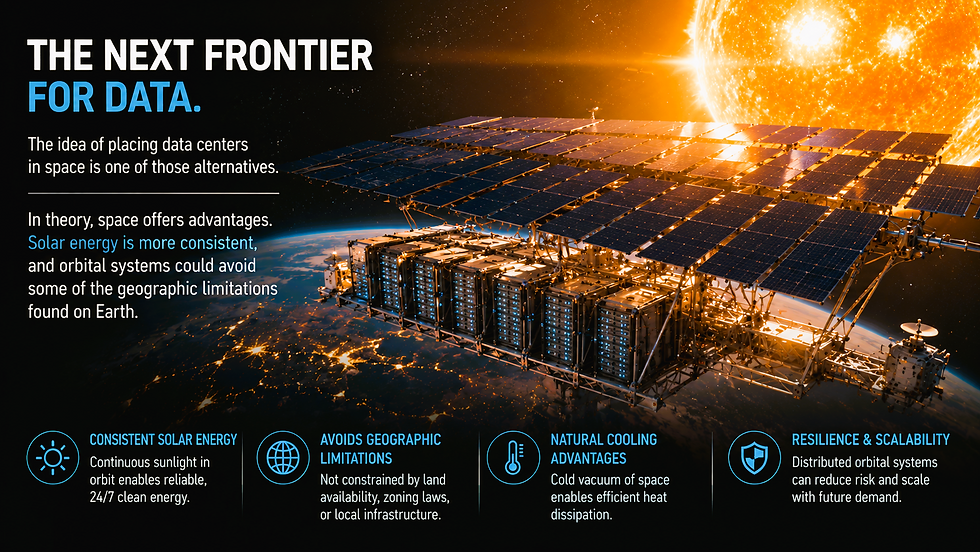
In theory, space offers advantages. Solar energy is more consistent, and orbital systems could avoid some of the geographic limitations found on Earth. However, these advantages come with equally significant challenges. Heat dissipation, construction logistics, maintenance, and cost would all require entirely new engineering solutions.
A data center in orbit would still need to remove heat, but without the benefit of air or water-based systems, it would have to rely on radiative cooling and other less conventional methods.
What the Space Concept Actually Signals
The important takeaway is not whether data centers will move into space. It is why the idea is being considered at all.
The discussion reveals that the demand for AI infrastructure is growing faster than the current physical environment can easily support. The industry is not just building bigger facilities. It is beginning to encounter real limits across power availability, cooling capacity, land constraints, and infrastructure timelines.
When all of those pressures build at the same time, the conversation naturally expands beyond traditional solutions.
Why This Matters Going Forward
The next phase of data center development is not just about scale. It is about sustainability and feasibility.
As AI systems become more integrated into daily life, the demand for continuous computation will increase. Autonomous systems, robotics, real-time analytics, and connected infrastructure all depend on reliable, high-performance computing environments.
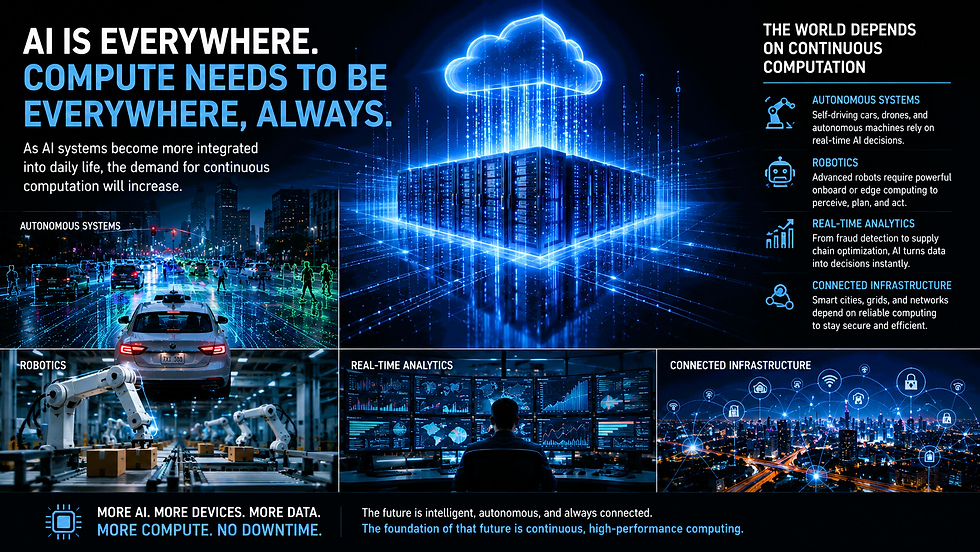
This creates a long-term challenge. How do you continue to scale AI infrastructure when the supporting systems are already under strain?
Conclusion
The idea of space-based data centers may sound extreme, but it highlights a very real issue. AI infrastructure is expanding faster than traditional systems can easily support.
The current wave of data center construction is not just about growth. It is about reaching the limits of what existing infrastructure can handle.
That does not mean the solution will be in space. But it does mean the problem is real.
And as demand continues to rise, the conversation about how to support that demand will only become more important.
If information is Power, then identifying and exposing hidden constraints is a Superpower.
Which would you rather have driving your business decisions?


Comments