
GDP Report and GDP Growth: Economic Risk Analysis Beneath a Positive Result

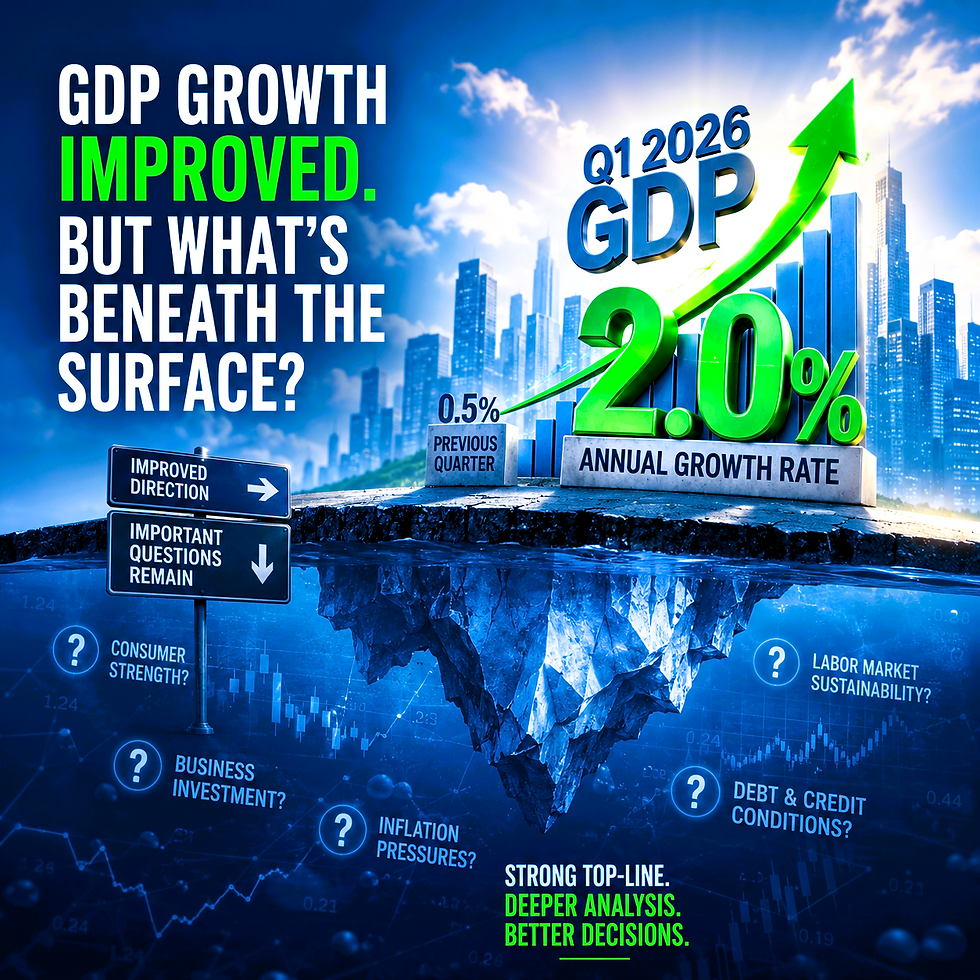
A positive GDP report can be accurate and still leave important questions unanswered. That is the issue many decision-makers face when reading a strong top-line result. The first-quarter 2026 GDP release showed real GDP increasing at a 2.0 percent annual rate after 0.5 percent in the prior quarter. That means GDP growth improved, and that improvement matters. The economy moved in a better direction than it did in the previous quarter.
But for investors, executives, analysts, lenders, and planners, direction alone is not always enough. A positive quarter can still carry conditions beneath the surface that affect how much confidence a user should place in the result. That is where economic risk analysis becomes useful.
GDP Report, GDP Growth, and Economic Risk Analysis
The official GDP report answers the first question. Did the economy grow faster than it did in the prior quarter. Yes. That should be preserved clearly and without distortion. But there is a second question that matters just as much for real-world decisions. How strong was the quality of that GDP growth, and how much confidence should users place in the result as a sign of durable expansion.
Quincy is designed to work alongside existing systems by helping users examine what a positive GDP report may still leave unresolved. It does not replace the accepted standard, and it does not require the official result to be wrong in order to add value. Its role is to help decision-makers look beyond the first answer and consider whether the broader conditions underneath the quarter support the same level of confidence as the top-line GDP result.
What the Standard GDP Report Shows
The standard reading of the quarter is constructive. GDP growth accelerated from the prior quarter. Consumer activity contributed positively. Investment contributed positively in the aggregate. Government spending added support. Exports also contributed positively, even though imports reduced part of the gain. From a broad reading, the quarter improved and the GDP report supports that conclusion.
That matters because the economy was not moving backward in this release. The positive result was real. For many readers, that may be enough. But for anyone making forward-looking decisions, the deeper issue is whether the quarter was simply better than the last one or whether it was strong enough to signal a cleaner and more durable expansion story.
Why a Positive GDP Report Can Still Carry Risk
One of the biggest mistakes in economic interpretation is assuming that a positive quarter automatically means a clean quarter. GDP growth can improve while still carrying unresolved pressure points. A report can be positive without being broad. It can be constructive without being fully durable. It can support a better near-term reading while still leaving enough uncertainty to change how a serious decision-maker interprets the quarter.

That is why economic risk analysis matters. It helps separate a positive result from a fully trusted result. A quarter does not need to be negative to deserve caution. It only needs to be less complete, less broad, or less stable than the top-line number may imply.
Inflation Pressure Still Matters
One of the clearest issues beneath the quarter was inflation pressure. A stronger quarter means less when inflation remains elevated enough to reduce how convincing the growth feels underneath the surface. Users do not only care whether the number improved. They care whether the improvement reflects solid underlying strength or whether some of the apparent momentum is still being diluted by persistent price pressure.
This matters because inflation can change the interpretation of otherwise positive economic data. A GDP report may look constructive on paper while still leaving households, businesses, and planners with a more limited sense of real underlying strength. That makes inflation a major part of economic risk analysis even in a quarter that came in positive.
GDP Growth Was Positive but Not Fully Broad
Another issue is breadth. GDP growth can be positive without being evenly supported across the economy. Some parts of the quarter were clearly constructive, but that does not automatically mean the overall expansion was broad-based. A quarter can improve while still leaning more heavily on selected categories than on a wide and balanced foundation.
That distinction matters because narrow strength is often less durable than broad strength. For decision-makers, the difference between selective support and generalized support can materially change how a positive GDP report should be used in planning, investment interpretation, and risk assessment.
Import Drag and Uneven Strength
Import drag also matters when reading the quarter. Domestic activity can look better while part of that strength is offset elsewhere in the report. That does not erase the positive GDP growth result, but it does make the quarter more conditional. A user trying to understand how secure the improvement really was should care whether the gains reflected a cleaner internal strengthening pattern or whether parts of the quarter remained more uneven.
This is why economic risk analysis cannot stop at the top-line GDP result. A positive quarter may still contain enough imbalance to justify a more careful reading. That is especially true when the goal is not just to describe the quarter, but to decide what the quarter means.
Temporary Support and Revision Sensitivity
Another reason caution matters is that not every positive quarter carries the same level of stability. Some supports may prove more temporary than they first appear. Early estimates can also change as later data fills in a more complete picture. That means a good quarter can still deserve a conditional reading if too much confidence is being placed on a first-look result.
For decision-makers, this is not a technical side note. It is part of the real risk. A positive GDP report can influence sentiment, market interpretation, and business planning immediately, even though some parts of the quarter may become clearer only later. That gap between first impression and fuller confirmation is exactly where economic risk analysis becomes valuable.
Why This Matters for Investors and Decision-Makers

Small structural issues can have large practical consequences. A quarter does not need to collapse to change the decision-risk profile. It only needs to be less durable, less broad, or less settled than the top-line number suggests. That difference matters to investors trying to judge momentum, executives making capital decisions, lenders assessing exposure, and planners deciding how much confidence to place in the current environment.
A strong GDP report may be enough for a headline takeaway. It is not always enough for a high-stakes decision. That is the gap Quincy is meant to help address. It helps users consider whether the positive result should be read simply as good news or as good news with important conditions still attached.
Final Takeaway
The first-quarter 2026 GDP report showed real improvement, and that fact remains intact. GDP growth accelerated, and the quarter was better than the one before it. But a positive GDP report does not automatically mean the picture is fully broad, fully clean, or fully durable. That is why economic risk analysis matters. Quincy helps decision-makers look beyond the initial positive result and recognize where inflation pressure, uneven strength, import drag, and other unresolved conditions may still affect the meaning of the quarter. The value is not in challenging the official result. The value is in helping users see what the official result may not fully settle on its own.


Comments