
Understanding the CEO Compensation and Employee Pay Gap: A Critical Analysis

The Importance of Examining Compensation Structures
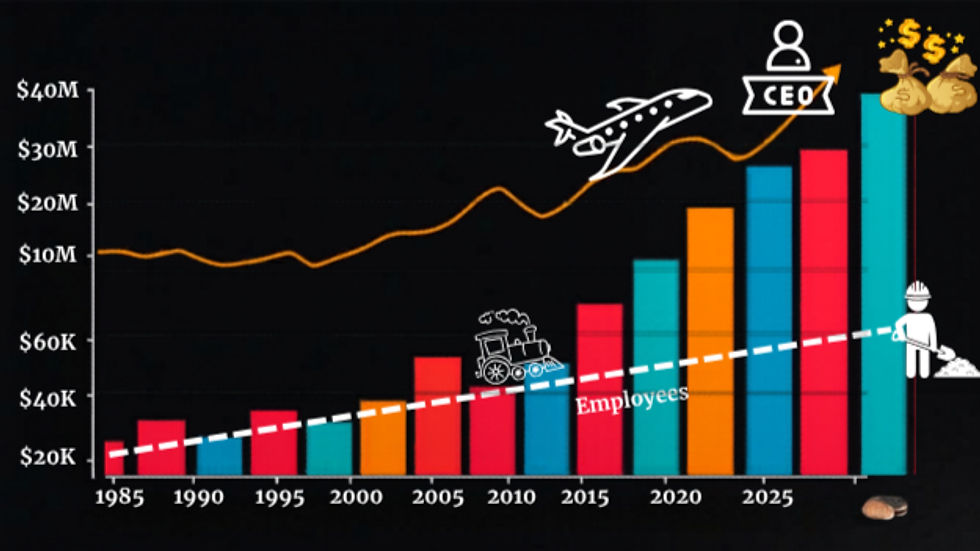
There comes a point when the gap in compensation ceases to be a mere business feature and transforms into a significant signal. This signal highlights the growing distance between CEO compensation and employee pay, making it increasingly difficult to overlook.
This discussion is not an argument against rewarding leadership or recognizing success. It does not claim that everyone within a company should earn the same salary. Such an idea is neither realistic nor beneficial.
The real question is whether the overall compensation structure remains sensible.
A company can showcase strong earnings and justify executive incentives while simultaneously revealing deeper issues through the disparity between top and bottom pay. When the gap becomes pronounced, it shifts from being a simple difference in salary to a reflection of varying economic realities within the same organization.
Why CEO Compensation and Employee Pay Matter Together
The widening gap between CEO compensation and employee pay is not merely a wage issue. It serves as one of the clearest indicators of structural imbalance within a modern company. When CEO compensation ascends into a different economic realm while employee pay remains tethered to daily financial pressures, the company begins to disclose more than just a compensation policy.
The Usual Debate Misses the More Revealing Question
Public discussions about pay often fall into predictable patterns. One side views criticism of executive pay as mere resentment, while the other sees every compensation gap as irrefutable proof of injustice. Both perspectives fail to address the more profound issue at hand.
The critical question is not whether a CEO should earn more than an employee. Of course, that can make sense. The more important question is whether the scale of the gap feels proportionate to the organization it represents. When the compensation gap becomes extreme, the company starts to resemble two distinct realities operating under a single brand.
The Shift Matters
This shift is significant.
The Quantitative Side of the Gap
There is an obvious numerical aspect to this topic, but the meaning behind those numbers is often misinterpreted.
The issue is not solely the ratio itself; it is what compensation enables.
At the top of a company, compensation can create margin. It can absorb volatility, build assets, increase optionality, and transform short-term uncertainty into manageable risks. Conversely, at the lower end, pay may remain so close to essential expenses that even a minor disruption can destabilize everything.
This is not merely a difference in income; it is a difference in resilience.
This is where the subject transcends a mere headline. A compensation structure does not just indicate who earns more; it reveals who can withstand pressure, who can recover from shocks, and who remains vulnerable despite contributing to the same enterprise.
In this sense, the gap is not just a number. It represents a distribution of stability.
The Qualitative Side of the Gap
Not all imbalances are visible in a spreadsheet.
The qualitative aspect of this issue is equally important.
A widening gap between CEO compensation and employee pay can alter how a company is experienced internally. It can affect whether leadership language feels credible. It can influence whether workers perceive the institution as disciplined or selectively disciplined. It can also determine whether the compensation system appears connected to effort, contribution, and everyday reality.
This is where the conversation shifts beyond envy and into coherence.
People do not need equal outcomes to recognize when something feels misaligned. They sense it when sacrifice becomes routine at one level while exceptions become routine at another. They notice it when the language of restraint is directed downward, while the language of reward is directed upward. They recognize it when the internal logic of the company begins to feel less like a cohesive structure and more like a separation.
This perception holds more significance than many organizations realize.
Once legitimacy starts to erode internally, the issue transcends financial design. It becomes interpretive. The company may continue to function, but it begins to lose its sense of purpose.

When the Top and Bottom Stop Living in the Same Company
There comes a point when the compensation gap suggests that the top and bottom of a company are no longer experiencing the same economic reality.
At the top, compensation can support patience, protection, and long-term planning. At the bottom, compensation may remain so closely tied to daily costs that life becomes a series of trade-offs, exposure, and narrow margins for error.
When this occurs, the issue is not simply that one role is rewarded more than another.
The real issue is that the organization may have drifted into two different definitions of what it means to work within that company.
This is why the gap serves as a valuable signal. It does not answer every question on its own, but it highlights areas where closer examination is necessary. It indicates where visible outcomes may no longer align with the underlying structure that produces them.
What This May Reveal About Modern Companies
The most revealing aspect of this debate is not whether a compensation package can be justified.
It is whether the company as a whole can still be described as balanced.
A company can satisfy investors, meet legal requirements, and adhere to prevailing norms while still producing an internal arrangement that feels increasingly detached from everyday life. It can justify each pay decision individually while failing the broader test of coherence when viewed as a whole.
This is where many organizations become challenging to interpret at face value.
The visible compensation narrative may not reflect the real story. The more critical issue may lie beneath the surface: what is being preserved, what is being compressed, and what the company is quietly normalizing through its reward system.
This is the point where compensation shifts from being a narrow business topic to becoming a lens through which we can understand deeper issues.
Is There a Fair and Equitable Solution?
There exists a formula to bridge the significant gap fairly. Public corporations with substantial disparities could be restructured so that executives receive fair compensation, while employees—the backbone of the business—earn a paycheck that does not leave them in negative equity each month just to cover living expenses.
While median pay can be useful, it can also be misleading. The middle of a company does not equate to the bottom. A robust middle layer of managers, analysts, specialists, or technical workers can elevate the median while leaving the lowest full-time roles far below a livable standard.
This is why median salary alone does not answer the question. A company may point to a healthy median as proof of fair compensation. However, if a teller, call center worker, customer service representative, warehouse employee, or entry-level operations worker cannot realistically meet monthly obligations, then the company is not balanced in any meaningful sense.
The most effective model should not be based solely on poverty or median salary. It should begin with a protected local floor. This floor should reflect what it takes for a full-time worker in a specific area to maintain a functional standard of living. It does not need to promise luxury; it only needs to ensure that the role is viable.
Once that local floor is established, the next question becomes whether the highest-paid executive compensation remains proportionate to the lowest full-time pay. This does not imply that the CEO and the entry-level worker should earn nearly the same amount. Instead, it means the gap must remain within a defensible range that is proportionate rather than excessive.
This is where the gap between CEO compensation and employee pay transforms into a more serious business measure rather than just a political slogan. It becomes a test of whether a company is rewarding leadership while still maintaining a workforce structure that is livable at the bottom.

At QSFramework.com, Quincy can apply the Quantitative Semantic Framework to your business model and offer a viable solution.
Conclusion
The debate surrounding CEO compensation and employee pay is often framed too simplistically to be genuinely useful.
This is not merely a conflict between market logic and moral outrage. It is not just a discussion about fairness. It is a question of whether a company’s internal reward system still makes sense as a cohesive structure.
When extraordinary rewards at the top coexist with persistent strain at the lower end, the real issue is not whether each figure can be justified. The real issue is whether the system they belong to still appears balanced.
The gap between CEO compensation and employee pay does not explain everything.
But it does reveal where the visible narrative may be incomplete.
In modern companies, that may be the most crucial area to investigate.

FAQ
Why does the gap between CEO compensation and employee pay matter?
Because it can reveal whether a company’s reward structure still feels proportionate, coherent, and economically believable across different levels of the organization.
Does a high CEO-to-worker pay gap automatically mean a company is unfair?
No. Industry, geography, workforce composition, and compensation design all matter. However, a large spread can still signal deeper imbalances worth examining more closely.
Is this only a wage issue?
No. It also encompasses resilience, legitimacy, structural coherence, and whether one company is quietly operating with two very different lived realities inside it.


Comments