
AI Consulting Value: Why AI Efficiency Doesn't Devalue Expert Insight

AI Consulting Value is Being Redefined
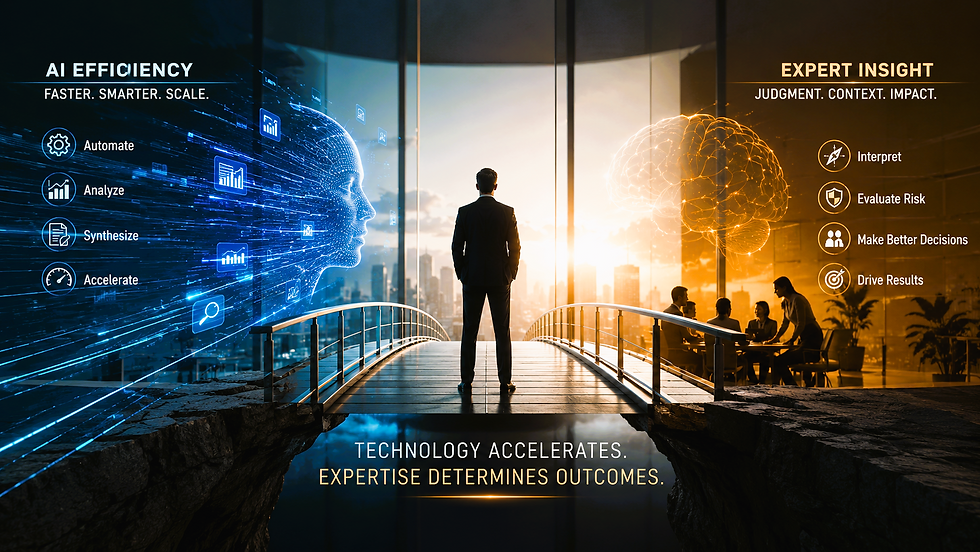
AI Efficiency accelerates delivery, but Expert Insight still determines whether organizations make sound decisions, manage risk, and achieve real transformation.
The consulting industry does not have a demand problem. If anything, the pressure on leaders has intensified. Organizations are still pushing through digital transformation, cloud migration, cybersecurity modernization, operating-model redesign, and enterprise AI adoption. The difference is that clients now have a sharper question than they did a few years ago: if consulting firms can move faster with AI, what exactly are they paying for?
That question is not superficial. It goes to the center of how consulting has long been priced and perceived. For decades, the value of advisory work was made legible through visible effort. Clients saw large teams, extended timelines, workshops, requirement sessions, documentation cycles, and long implementation tracks. Whether or not every hour produced equal value, the labor itself made the bill feel understandable. Effort was visible, and visibility made cost easier to defend.

AI has disrupted that visual logic. Research can be compressed. Documentation can be drafted faster. Analysis can be scaled more quickly. Some technical tasks that once required weeks of coordinated effort can now be completed in a fraction of the time. From the client side, that naturally creates pricing pressure. If the work looks faster and leaner, many assume the price should fall in direct proportion.
But that is where the real misunderstanding begins.
The Problem Was Never the Hours Alone
The best consulting engagements were never valuable simply because they consumed time. They were valuable because they helped organizations avoid expensive mistakes, make higher-quality decisions, and move through uncertainty with more confidence. A flawed modernization roadmap can cost millions. A weak governance model can stall transformation for months. A badly timed strategic decision can create downstream operational and political damage that far outweighs the cost of the advisory work itself. AI may shrink parts of the delivery process, but it does not shrink the consequences of getting the decision wrong.
This is the core issue in AI Consulting Value. Clients are not wrong to notice that AI changes the economics of delivery. Consulting firms are not wrong to argue that solving the same business problem still carries the same responsibility. The tension exists because the traditional model was built around labor visibility, while the modern value proposition is increasingly built around judgment, accountability, knowledge infrastructure, and outcome quality.
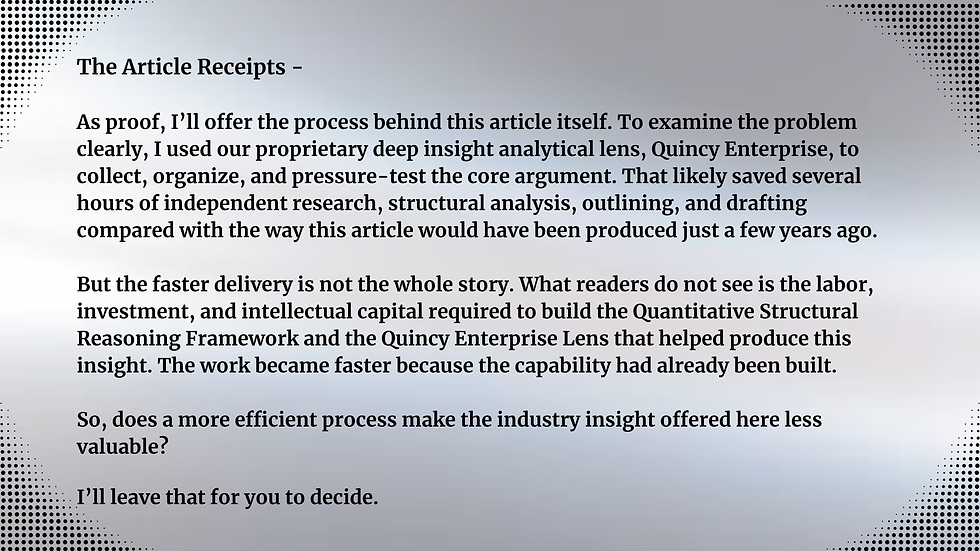
What makes that tension more difficult is that the most important investments are often invisible. Firms are building internal AI platforms, proprietary methods, quality controls, governance frameworks, and specialized knowledge systems that improve delivery quality and reduce risk behind the scenes. To a buyer, the output may simply look faster. What they often do not see is the intellectual capital and operating maturity that make faster delivery trustworthy in the first place.
That is why AI Efficiency changes the optics of consulting more than the stakes of consulting. It can reduce manual effort. It can compress timelines. It can improve throughput. What it does not do is eliminate the need for interpretation, prioritization, trade-off analysis, stakeholder alignment, or responsibility for the final recommendation. Research increasingly points in the same direction: AI can improve speed and decision support, but organizational barriers, governance demands, and human oversight remain central to successful enterprise use.
Faster Delivery Does Not Mean Simpler Transformation
Some firms have responded by moving toward fixed fees, packaged services, or outcome-based pricing. Those approaches can help, especially when buyers want more predictability. But they do not fully solve the problem because enterprise transformation rarely behaves like a clean, predictable production process. Legacy environments create surprises. Data issues surface late. Governance gaps slow progress. Stakeholder alignment breaks down. Resistance emerges inside the organization even when the technical path appears sound.
In practice, AI often automates the more repeatable portions of the work while leaving the hardest parts untouched. The difficult work is still the work that sits closest to ambiguity: deciding what matters, sequencing change, interpreting risk, aligning leadership, and maintaining implementation confidence when conditions shift. Those are not peripheral concerns. They are usually the difference between momentum and failure.
That makes Expert Insight more, not less, important in the next phase of consulting. Not because expertise should be romanticized, but because someone still has to connect analysis to consequences. Someone still has to identify what a model overlooks, where a recommendation is politically unworkable, where a dependency will delay execution, or where a fast answer is masking a fragile decision.
Where the Premium Moves Next
As execution becomes easier to automate, the premium moves toward decision quality. That is where the strongest consulting firms will distinguish themselves. Their value will not rest on how many hours they can sell or how much labor they can display. It will rest on whether they can help clients make smarter calls under pressure, reduce the probability of strategic error, strengthen governance, validate the path to execution, and create confidence across stakeholders.

This is also where strategic partnerships become more important. When firms expand their value with specialized capabilities, implementation safeguards, compliance support, validation frameworks, or deeper industry expertise, they give clients something more tangible than speed alone. Buyers may resist paying yesterday’s fee for faster output, but they will still invest in lower risk, stronger execution, and better business outcomes.
The future question for consulting is no longer whether AI will make the work faster. It already has. The better question is what remains valuable once speed is no longer rare. The answer is not hidden in the hours. It is hidden in the clarity. Firms that can make complexity easier to navigate, decisions easier to trust, and transformation outcomes easier to achieve will keep their relevance even as delivery models evolve. In that environment, efficiency is expected. Judgment is scarce. And scarcity is where value endures.
If information is Power, then exposing hidden information in your data is a Superpower. Which would you rather have driving your clients business decisions?



Comments